Definition
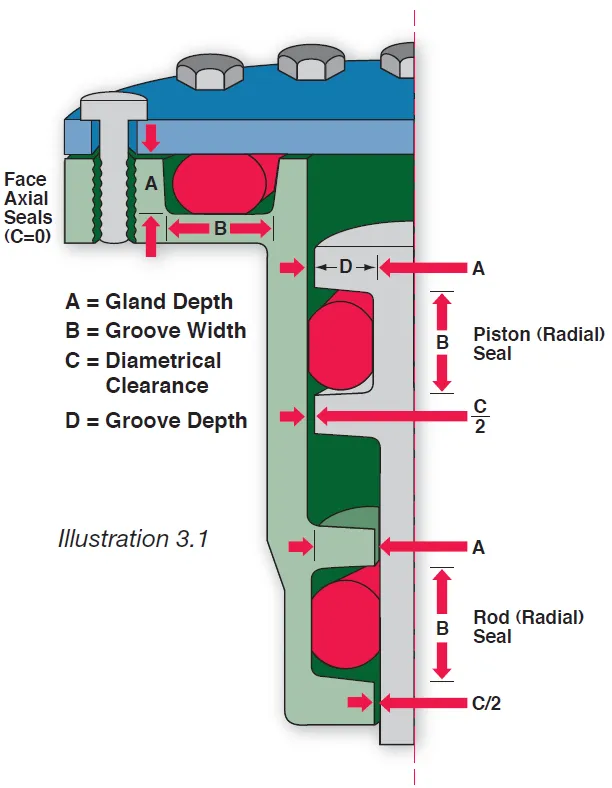
An O-ring is a doughnut-shaped object or torus. The opposite sides of an O-ring are squeezed between the walls of the cavity or “gland” into which the O-ring is installed. The resulting zero clearance within the gland provides an effective seal, blocking the flow of liquids or gases through the gland’s internal passage. An O-ring is defined by its dimensions (based on inside [hole] diameter and cross section), durometer (Shore A hardness), and material composition. Illustration 3.1 demonstrates three applications showing the two basic categories of O-rings: STATIC– contained within a non-moving gland as in a face seal, and DYNAMIC– contained within a moving gland as in a piston or rod seal.
Why an O-Ring Works
As Illustration 3.1 shows, a properly designed sealing system incorporates some degree of initial O-ring compression. At atmospheric pressure, only the resiliency of the compressed O-ring provides the seal. However, as system pressure activates the seal, the O-ring is forced to the low pressure side of the gland. Designed to deform, the O-ring “flows” to fill the diametrical clearance and blocks any further leakage. Illustration 5.1 in section 5 shows a progressive application of pressure and the effect it has on the seal. Pressure, as well as many other considerations, determine the effectiveness of a seal. These considerations are highlighted throughout this design guide.
Dimensional Considerations
Inside Diameter
To provide an effective seal, the O-ring’s inside diameter (I.D.) must be smaller than the piston groove diameter, so that the O-ring is slightly stretched, fitting snugly in the groove. This stretch should be between 1%-5% with 2% as the ideal in most applications. A stretch greater than 5% is not recommended. The resulting stress on the O-ring will cause accelerated aging and cross section reduction. Exception to this rule is a floating seal. These are O-rings that are allowed to sit in grooves freely or “float”. These are used in applications where some leakage is allowed and less friction is required.
Common Applications